Claude, ChatGPT, and other AI tools can now write functional code, debug errors, and build simple applications from a plain English description. This is not a hypothetical anymore. It is what happens every day inside thousands of companies right now.
So the question on a lot of minds, especially parents advising their children and students choosing a degree, is completely reasonable: if AI can write code, why would anyone spend a year or more learning to do it themselves?
The honest answer is more specific than a simple yes or no, and it requires looking at data most articles skip. This piece covers what is actually happening in the job market, what is genuinely changing about the work, and what a rational person should do with this information right now.
For: Students, parents, career switchers, and anyone wondering whether it still makes sense to invest months learning to code when AI can already write working software.
What This Guide Covers
- What is actually happening to entry level coding jobs, with real numbers
- Why the "coding is dead" and "coding is fine" arguments both miss the point
- What AI actually automates versus what it does not
- The specific coding skills that still matter in 2026
- Who should still learn to code, and who might not need to
- How to learn coding differently than you would have five years ago
- A practical framework for making this decision
The Uncomfortable Data First
Before any reassurance or any alarm, here is what the numbers actually show, because this is the part most "don't worry, coding is fine" articles skip entirely.
| What changed | The number |
|---|---|
| US developers aged 22 to 25 in work, since 2024 | Down nearly 20 percent |
| Entry level developer hiring in 2024 | Down about 25 percent |
| Applicants seen for a single junior web developer role | Often 1,200 or more |
| Share of code authored by AI, Q3 2025 to Feb 2026 | 22 percent to 27 percent |
| Developers using AI assistants daily | About 85 percent |
A Stanford study from April 2026 found that employment among US developers aged 22 to 25 has dropped by nearly 20 percent since 2024, while the number of older, more experienced developers in the workforce continued to increase.
These facts are connected. AI is measurably reducing demand for the specific, narrow kind of work that used to define entry level developer jobs: writing straightforward, boilerplate code from clear specifications. That work is precisely what AI tools are best at.
If your mental model of "learning to code" is "learning to write the kind of code a junior developer wrote in 2022," the honest answer is that this specific path has genuinely gotten harder, and pretending otherwise would not be useful to you.
But the Full Picture Is More Complicated Than the Bad News
Here is the part that the alarming headlines usually leave out.
The overall demand for software development has not shrunk. The US Bureau of Labor Statistics projects software development jobs to grow 15 percent through 2034, well above the average for all occupations. Software development roles have grown roughly 22 percent more positions compared to 2020. Microsoft, Amazon, and Alphabet alone are projecting around 495 billion dollars in 2026 capital expenditure, much of it tied to AI infrastructure that itself needs to be built, maintained, and integrated by people who understand software.
So the picture is not "fewer software jobs." It is "the same or growing number of software jobs, distributed differently, with a much harder squeeze specifically at the bottom rung that used to be the easiest way in."
That distinction matters, because the question is not "is coding dead." It is "what kind of coding, learned in what way, aimed at what kind of role, still makes sense."
What AI Actually Automates, and What It Does Not
Understanding this distinction precisely is the most useful thing you can take from this article.
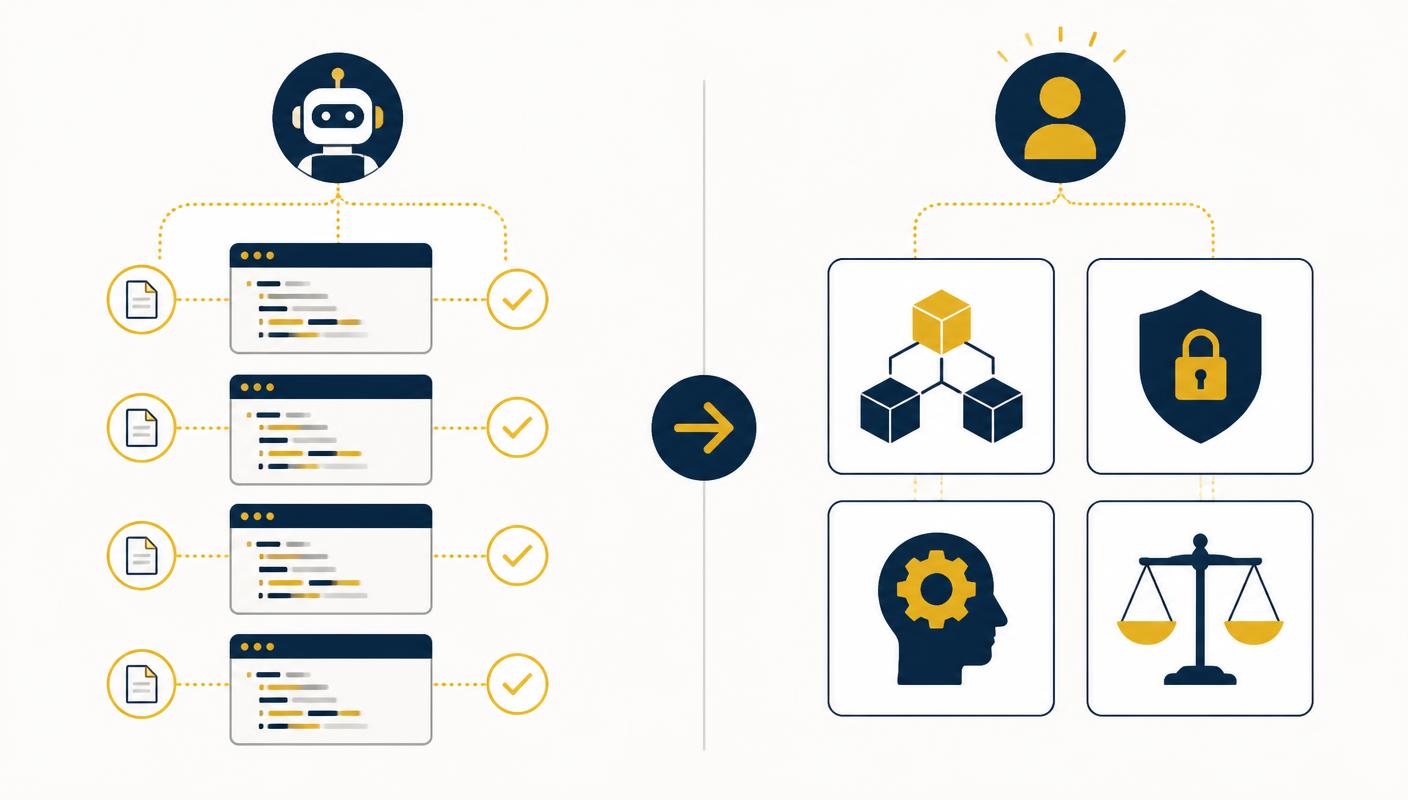
What AI is genuinely good at and is replacing:
Writing boilerplate code from a clear specification. Generating CRUD screens, basic UI scaffolding, and repetitive logic. Producing a first draft of a function when you can describe exactly what it needs to do. Writing straightforward test cases. Explaining what an unfamiliar piece of code does.
What AI is not replacing, and what companies still explicitly hire for:
Deciding what to build in the first place, and judging whether the result is actually good. At companies that use AI most heavily, the code produced is still reviewed and approved by human engineers, and most developers report they do not fully trust what AI produces without checking it. Someone still has to be accountable for whether the software works correctly, securely, and at scale, and AI does not carry that accountability.
Architectural decisions about how a large system fits together. Security and reliability trade offs that require judgment about consequences, not just pattern matching. Understanding a business problem well enough to translate it into the right technical approach, which is a different skill from writing syntax. Integrating multiple systems, including AI systems themselves, into something that works together reliably.
The clearest way to say this: AI writes code, but humans still build software. Writing code is one narrow task inside the much larger job of building something that works. AI has gotten dramatically better at the narrow task and has not meaningfully closed the gap on the larger job.
Why the Entry Level Specifically Got Harder
Junior developer roles have historically existed partly to train people through exactly the kind of repetitive, well specified coding tasks that AI now handles well. A junior engineer spending their first year writing straightforward CRUD functionality under supervision was, in a real sense, being paid to learn by doing tasks valuable enough to be worth assigning to a human, but simple enough that a relatively inexperienced person could do them competently.
AI tools now do a meaningful share of that specific category of work faster and more cheaply. This does not mean companies do not need developers. It means the traditional on ramp has partially closed, while the roles requiring judgment, system design, and accountability remain in strong demand and are, if anything, becoming more valuable because the supply of people who can reliably do that work has not increased as fast as demand.
So Should You Still Learn to Code? The Honest Answer
Yes, coding is still worth learning in 2026, but the reason to learn it and the way you should learn it have both changed.
Learn coding if any of these apply to you:
You want to build software, applications, or systems, meaning coding is core to what you want to do professionally, not a side skill.
You are pursuing a field like data science, AI engineering, cybersecurity, or DevOps, where coding literacy is a prerequisite for the actual specialized work.
You want to genuinely understand, review, and improve AI generated code rather than blindly accepting whatever it produces. Developers who know how to work with AI are consistently more valuable than those who avoid coding literacy altogether, precisely because someone competent has to check the output.
You are in any role, technical or not, where basic scripting or automation literacy would meaningfully increase your effectiveness.
Coding might not be the right specific investment if:
Your actual goal is a general business or communication skill and coding was suggested to you as a vague, generically useful thing to learn without a specific application in mind.
You are hoping that surface level syntax alone, without deeper problem solving or systems thinking, will be a reliable path to a job. That specific bet has gotten measurably weaker, and the data above explains why.
What "Learning to Code" Should Actually Look Like Now
Learn fundamentals, not just syntax. Logic, data structures, and how systems fit together remain valuable and are not what AI has automated away. Memorizing syntax has always been the least durable part of learning to code. What AI cannot do for you is the thinking: breaking a problem into logical steps, understanding why one approach beats another, and recognizing when a solution is actually correct rather than superficially plausible.
Use AI as an accelerant for understanding, not a replacement for it. Ask an AI tool to explain why a piece of code works, not just to produce the code. Ask it to explain a bug rather than simply fixing it for you. If you consistently let AI do the thinking while you do the typing, you are optimizing for exactly the shallow skill set the market has gotten harder for. Used well, AI makes you more capable, faster, than someone learning the same material without it. GitHub Copilot for Beginners walks through that habit in practice.
Go beyond generic tutorial projects. Pick a project one level beyond comfortable and build it properly, including the tedious parts: error handling, testing, documentation, and actually deploying it somewhere real. A few real, working, well explained projects demonstrate judgment and follow through that a string of half finished tutorials does not.
Consider where the demand actually is. Data engineering, DevOps, tooling, and coding embedded in a domain like healthcare or finance often face meaningfully less competition than generic front end web development, precisely because they require coding plus context. Your first role might look different from the default "junior web developer" path, and that is a reasonable adjustment rather than a failure.
Treat working with AI coding tools as a skill in itself. Reading code, debugging AI generated output, writing effective prompts for coding tasks, and reviewing AI suggestions critically is now a specific, learnable skill that differentiates candidates.
The Roles That Remain Strong Even With AI Fully Adopted
| Role category | Why AI does not replace it |
|---|---|
| Software engineers and architects | System design and technical decision making, not just implementation |
| AI and ML engineers, data scientists | They build and maintain the AI systems themselves |
| DevOps and infrastructure | Accountable for reliability, security, and scale |
| Domain specialists (health, finance, industrial) | Domain understanding matters as much as the code |
| Technical leads and engineering managers | Translate business needs into direction and own outcomes |
Notice the pattern: judgment, accountability, and integration, layered on top of coding ability rather than coding ability alone.
A Practical Framework for Making This Decision
- Identify your actual goal, specifically. "I want to learn to code" is too vague to act on. "I want to become a data analyst," "I want to build my own app," or "I want a career in cybersecurity" each point toward a different amount and type of coding knowledge, learned in a different order.
- If your goal involves building software professionally, commit to fundamentals over syntax memorization. Data structures, algorithms, how databases work, how systems communicate. This is the part AI has not devalued.
- Build real projects that go beyond tutorial following, and use AI deliberately as a learning accelerant. Ask it to explain, not just to produce.
- Aim your first professional target beyond the most saturated entry point. Data adjacent, domain specific, or infrastructure adjacent roles have measurably thinner applicant pools.
- Treat "working effectively with AI coding tools" as its own explicit skill, not an incidental side effect of learning to code.
Frequently Asked Questions
Will AI eventually replace software engineers entirely?
Not in the way headlines suggest. AI is automating a significant share of the typing and boilerplate generation involved in coding, but someone still has to decide what to build, judge whether the result is good, and take accountability for it working correctly and securely. The job is changing substantially rather than disappearing.
Is it still worth doing a coding bootcamp in 2026?
It depends heavily on the bootcamp. A program focused narrowly on surface level syntax for generic web development, aimed at the most saturated entry level roles, is a weaker bet than it was several years ago. A program that teaches fundamentals deeply, includes real project work, and explicitly incorporates AI coding tools is a substantially stronger investment.
Should I learn to code before using AI coding assistants, or together?
You do not need to master programming before experimenting with AI coding tools, but building genuine fundamentals alongside AI use, rather than skipping straight to generated output you do not understand, is what determines whether you end up capable or dependent.
What if I only want a little coding to support a non technical career?
That remains genuinely useful and is a lower risk investment than aiming for a full software development career. Basic scripting and automation literacy increases effectiveness across marketing, finance, and operations without requiring you to compete in the crowded entry level developer market at all.
Are certain programming languages more at risk from AI than others?
AI tools are strongest on widely used, well documented languages with enormous amounts of existing code to learn from, such as Python and JavaScript. That does not make them worse choices. It reinforces that the durable value is understanding systems and logic well enough to direct and verify what the AI produces, whatever the language.
Run the Numbers on Your Career Plan
Whatever direction you choose, plan your career finances with these free calculators.
- Salary Calculator: see what a developer or tech role pays after tax
- Salary Negotiation Calculator: check a realistic range for your role, city, and experience
- Income Tax Calculator: understand your tax position before comparing offers