
An app raised 42 million dollars from investors by claiming it used AI to process customer purchases automatically. The real automation rate was zero. Every transaction was completed manually by human workers in the Philippines, sitting behind an interface designed to look like software was making the decisions. In 2025, the company's founder was charged with fraud by both the SEC and the Department of Justice.
This is not an isolated case. It has a name: AI washing, the practice of overstating AI capabilities in marketing, hiring, or investor communications without the operational substance behind the claim.
"We use AI" has become one of the least reliable signals in business. That matters when you are deciding whether to accept a job offer, join a startup, or trust a company's story about where it is headed.
The good news is that AI washing is detectable. Real AI adoption leaves observable traces. AI washing usually does not. This guide gives you specific things to check.
For: Job seekers evaluating AI-powered companies, professionals assessing employers, and anyone tired of seeing the word AI used without meaning.
What This Guide Covers
- What AI washing means, with real cases
- Why it matters for job seekers right now
- The four patterns AI washing usually follows
- Hiring red flags that reveal a weak AI story
- Interview questions that expose the truth quickly
- What genuine AI adoption looks like from the outside
- How AI claims can be used to frame layoffs
- A practical checklist to run before accepting an offer
What AI Washing Actually Is
AI washing is the business equivalent of greenwashing. Companies attach the word AI to products, processes, hiring announcements, and even layoffs to appear advanced and efficient when the actual AI involvement is minimal, nonexistent, or years away from being useful.
The scale is not small, and it is not limited to obscure startups.
Presto Automation described its drive-through ordering product as proprietary AI. The SEC found that, for a period, all deployed units actually ran on a third party's off-the-shelf speech recognition technology. Even after Presto built an in-house system, 70 percent of orders still required a human to step in and complete the interaction.
The Rabbit R1, a handheld device marketed as a standalone AI assistant, sold out its first production run on the strength of its AI positioning. Independent reviews later argued that much of the experience resembled existing language model access with scripted actions rather than the original, broader vision suggested by its marketing.
Coca-Cola's Y3000 was released with the claim that its flavor was "co-created with artificial intelligence." Journalists who asked how AI shaped the product struggled to get a specific explanation of the process.
Regulators have responded directly. The SEC's first AI-washing enforcement cases in March 2024 resulted in penalties of 225,000 and 175,000 dollars against two investment advisers for marketing AI capabilities they had not implemented as claimed. The FTC has pursued parallel enforcement through Operation AI Comply, including action against a service promoted as an AI lawyer without adequate evidence that its output matched a human attorney's quality.
Why This Matters for Job Seekers
If you are evaluating a job offer, this is not an abstract governance issue. It affects you in two direct ways.
First, your future skills depend on whether the AI story is real. If you join for the promised AI experience and discover a thin interface around someone else's service with little technical depth, the experience may not carry the market value you expected when you pursue your next role.
Second, AI claims can become a cover story for layoffs. Vague AI announcements that arrive alongside staff reductions, or a sudden emphasis on AI fluency just before cuts, deserve careful attention. The layoffs may be real while the AI explanation is overstated. In one widely reported case, a major fintech company's leadership said AI tools could perform work equivalent to thousands of employees before substantial cuts in February 2026. Outside reporting later questioned whether the deployed capability justified that framing.
Evaluating a company's real AI maturity before you join protects both your career development and your ability to assess the story if you are ever on the receiving end of it.
The Four Patterns of AI Washing
Understanding these patterns makes it much faster to evaluate a company's claims.
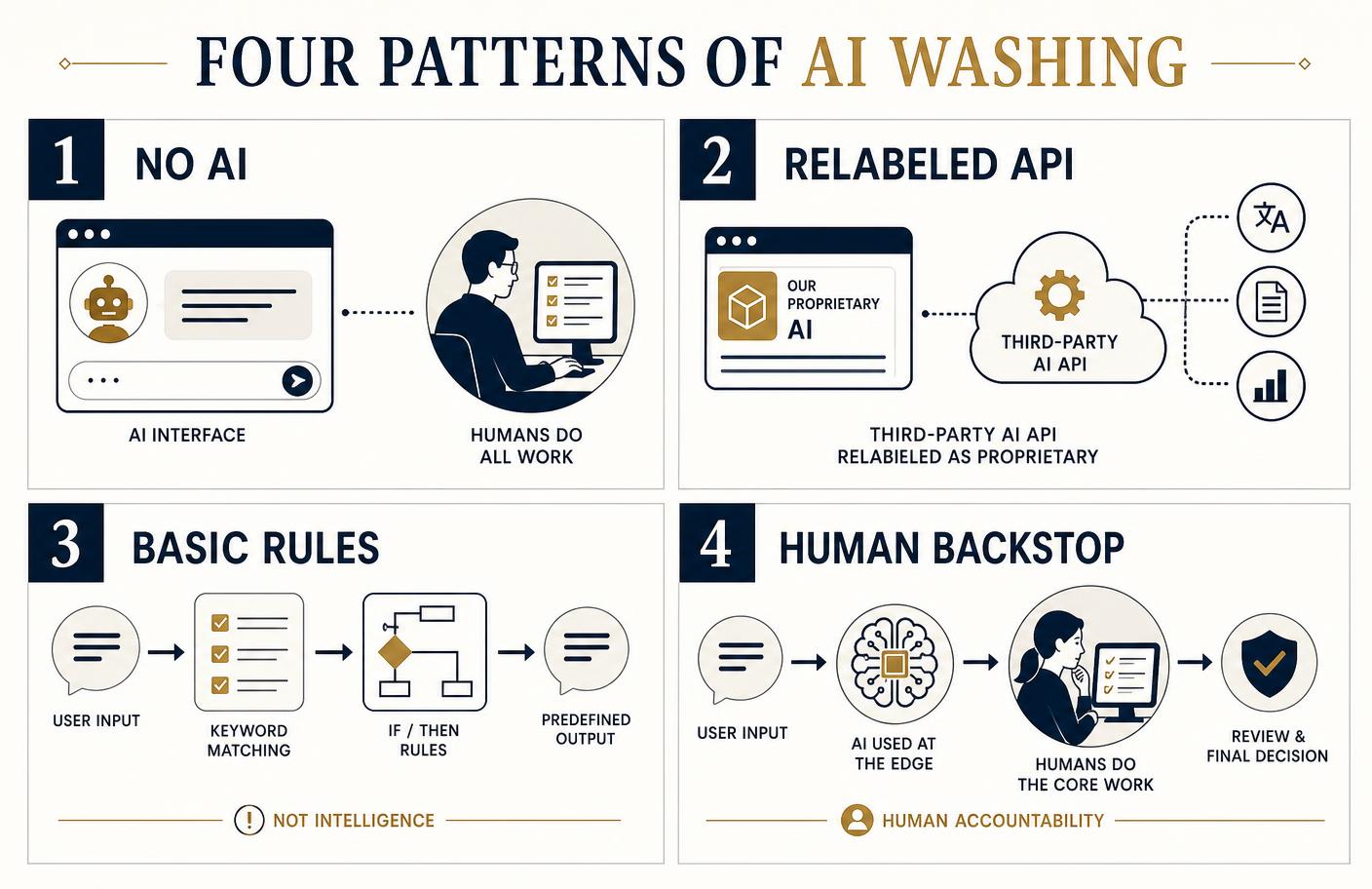
1. No AI at all
The product or process uses rules, manual work, or human labor behind an interface presented as intelligent software. This is the most serious version because it is closest to straightforward deception rather than exaggeration.
2. Third-party AI presented as proprietary
The company calls an external model from a provider such as OpenAI, Anthropic, or Google and presents the result as its own custom technology. Using an external model is not inherently a problem. The problem is claiming unique technology without clearly explaining what the company genuinely builds on top of it.
A thin wrapper can have little defensible advantage. It may be easy to reproduce, and changes to the underlying provider's pricing or behavior can reshape the product overnight.
3. Basic automation relabeled as AI
The system performs simple rules, keyword matching, or template filling but calls the output "AI-powered insights" or "intelligent automation." The result may still be useful, but the label misrepresents how it works.
4. Real AI at the edge, humans doing the core work
A genuine AI component exists, but human operators still complete most of the work presented as automated. Human review is normal in responsible AI systems. It becomes washing when the company hides its scale and implies that automation is doing work that people actually perform.
Hiring Red Flags to Watch
These signals are especially useful when evaluating a role or employer.
AI job titles without relevant requirements. If an AI Engineer posting does not mention Python, model APIs, machine learning frameworks, evaluation, data work, or any specific technical stack, the title may be decorative.
No foundational roles in the company's hiring history. Serious AI work often needs data engineering, model operations, evaluation, security, and governance support. A company claiming broad adoption without any of these capabilities may be describing an ambition rather than current reality.
AI roles repeatedly posted but never visibly filled. Roles that reappear for months, or hires that quietly vanish from the team soon after joining, can indicate that recruitment is supporting an external narrative rather than a stable operating need.
No growth in AI-adjacent headcount. If a company has called itself AI-first for two years while relevant technical hiring has stayed flat, its claims and operations may have diverged.
Claims spike around funding announcements. A sudden burst of AI language during fundraising, followed by silence, suggests the narrative may be aimed more at investors than customers or employees.
No acknowledgment of limitations. Mature AI teams encounter failures, uncertainty, bias, evaluation challenges, and human-review requirements. A uniformly triumphant story with no limitation or lesson sounds more like marketing than engineering.
Five Interview Questions That Expose the Truth
You do not need a technical background to run a meaningful check. A company with genuine substance can answer these questions specifically. A company relying on hype often falls back on marketing language.
1. "Can you walk me through the architecture at a high level?"
A genuine answer explains the data used, the model or approach, which steps are automated, and where people review the output. A weak answer repeats phrases such as "advanced algorithms" without describing a real process.
2. "What does the AI decide that a simple rule or template could not?"
This is one of the sharpest questions available. A strong answer describes pattern recognition, prediction, or language understanding applied to situations that could not be fully specified in advance. A weak answer describes a decision tree or keyword match dressed in AI language.
3. "What percentage still requires human intervention, and where?"
Genuine programs measure this because it affects cost, quality, and risk. Presto's disclosures showed that 70 percent of orders still needed a human agent. A team that has never measured the number, or becomes uncomfortable when asked, is giving you useful information.
4. "What measurable outcome has the AI produced?"
Real programs can usually cite a defined number of interactions, a reduction in processing time, or a before-and-after result. Klarna, for example, reported that its assistant handled 2.3 million customer conversations in its first month. A claim such as "it made us much more efficient" without a metric is a reason to ask again.
5. "How do you respond when the underlying model changes?"
This reveals whether the company understands its dependencies. A thoughtful team can discuss model monitoring, evaluations, fallback plans, cost changes, and how it decides whether to switch providers. A team that has never considered the question may not own the technology as deeply as its marketing suggests.
What Genuine AI Adoption Looks Like
Real programs tend to leave several visible signals:
- AI-adjacent hiring grows consistently rather than appearing only around announcements.
- Teams can name measurable outcomes, not just general improvements.
- Technical leaders can explain limitations and current problems openly.
- Job requirements match the title, seniority, and actual scope of the work.
- The company can explain which parts it builds and which parts it buys.
- Human intervention is measured and discussed as a normal operational metric.
- Model quality is evaluated against defined criteria before and after changes.
No single signal is proof. Together, they form a reliable picture of whether the AI story reflects operations or exists mainly for an external audience.
Look Beyond the Biggest Technology Markets
This framework matters in every growing AI job market. Local technology sectors often split between companies doing genuine production work and agencies combining existing model APIs with standard software services while presenting the result as proprietary capability.
The distinction directly affects the skills you can demonstrate in your next job search. Someone from a genuine AI team can discuss model selection, evaluation methods, data quality, production failures, monitoring, and tradeoffs. Someone whose experience involved only calling an external API may struggle when an interviewer asks for that depth.
That does not make API-based work worthless. Integrating external models well can require excellent product and engineering judgment. The important question is whether the company describes the work honestly and gives you meaningful ownership beyond a basic connection.
Your Pre-Offer AI Reality Check
Before accepting a role at a company built around AI, work through this list:
- Review its hiring history. Search public job posts from the last 12 to 24 months. Has relevant hiring grown gradually, stayed flat, or appeared only around one announcement?
- Ask about human intervention. Note how specifically and comfortably the interviewer answers.
- Request one measurable result. Look for an actual number rather than general enthusiasm.
- Search for honest limitations. Has the company ever acknowledged a challenge, mistake, or boundary in its AI work?
- Test technical ownership. Ask what happens when the underlying model or provider changes.
- Compare title with substance. If the role includes AI or machine learning, do its requirements match a genuine role at that level?
- Ask what you will own. Clarify whether you will work on data, evaluations, model behavior, production systems, or only a user interface around an external service.
A company does not need to pass every check perfectly. Early-stage teams can be small, and some technical details may be confidential. What matters is whether the people closest to the work can answer clearly, consistently, and without hiding behind slogans.
Frequently Asked Questions
Is every company using OpenAI, Anthropic, or Google models engaged in AI washing?
No. Using a third-party model inside a well-integrated product is common and reasonable. The concern begins when a thin interface is presented as unique proprietary technology, or when the company cannot explain the value it genuinely adds.
How can I check before an interview without asking anyone directly?
Review job postings over time, team profiles, public technical writing, engineering talks, product documentation, and customer case studies. The depth and consistency of those sources often reveal more than the marketing page.
What if a small startup has real capability but little hiring history?
Company size matters. A small team with a clear technical approach is different from a company that cannot answer specific questions. Focus less on the length of its history and more on whether founders or technical leads can explain the system, limitations, and outcomes precisely.
Should I avoid companies with heavy AI marketing?
Not automatically. Strong marketing and genuine substance can coexist. The goal is to distinguish marketing backed by operational evidence from marketing that replaces it.
Can AI washing create legal trouble for a company?
Yes. The SEC and FTC have already brought enforcement actions over misleading AI claims, including financial penalties. Criminal fraud charges can also follow when claims are deliberately fabricated to obtain investment or customer money.